
- Published on
Project: Birdi Pharmacy App
- Authors

- Name
- Gustavo Kuze
- About
- About the author
Introduction
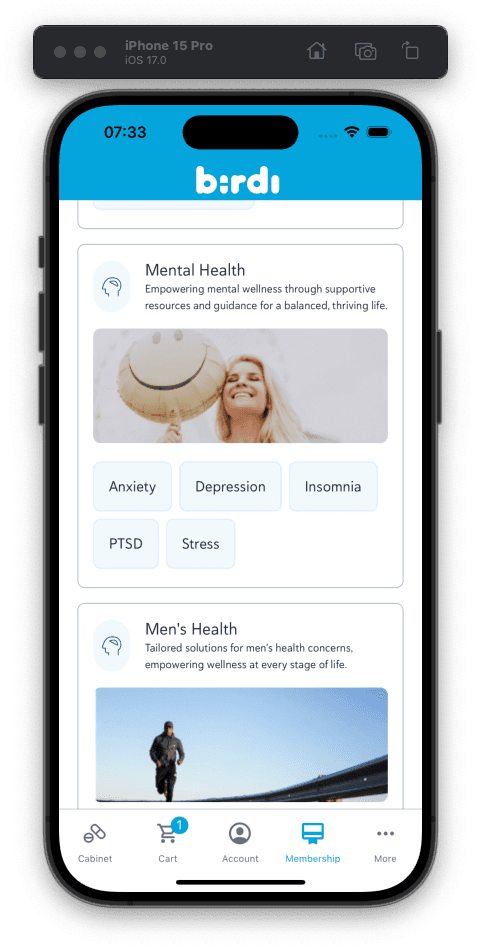
Birdi is a digital mail-order pharmacy that sets out to make purchasing prescription medications faster, easier, and more affordable. The platform combines low prices, free and flexible home delivery, and access to expert pharmacists — all from a mobile app. I contributed to the development of the Birdi Pharmacy iOS and Android app as part of the NTConsult team, helping to shape the core user experience around prescription management.
Product context
Birdi is designed for people who rely on recurring medications and want an alternative to traditional pharmacy chains. Users can manage all their prescriptions in one place, transfer existing prescriptions from other pharmacies, and track deliveries in real time — without leaving their couch.
The app is available on iOS (13.0+) and Android and serves more than 100,000 customers shipping over 600,000 prescriptions annually across the United States.
Key product capabilities include:
- Medicine Cabinet — a centralized view of all active prescriptions
- Rx Transfer — scan an existing prescription label to transfer it to Birdi in one step
- Order Management — place orders in seconds and track free standard or rush delivery
- Secure Messaging — chat directly with a licensed Birdi pharmacist
- Refill Reminders — automated alerts for upcoming refills and new prescriptions
- Auto Refill — opt-in automatic refill program for eligible medications
- Family Accounts — family organizers can manage prescriptions and payments for multiple members
- Telehealth Integration — schedule telemedicine visits for adults and minors, with prescriptions handled within the same flow
- Birdi Membership — tiered membership plans with expanded benefits and specialty prescription support
My contribution
Working within the NTConsult team alongside Birdi's product organization, my role focused on the React Native mobile layer of the application. The app presents a set of interesting engineering challenges that go beyond a simple CRUD interface.
Prescription management involves coordination between multiple asynchronous data sources: insurance plans, pharmacy benefit managers, delivery logistics, and telehealth providers. Keeping that complexity invisible to the user requires a clear separation between data-fetching, business rules, and the UI layer — something we had to be deliberate about as the feature surface expanded.
Some of the areas I worked on:
Prescription transfer flow
The transfer experience is a critical activation moment for new users. We redesigned the flow to become a single-step process — the user scans their existing prescription label and Birdi handles the rest. Reducing friction here directly impacts user retention.
Medicine Cabinet improvements
The Medicine Cabinet is the core screen most users land on after onboarding. We worked on making the prescription list more actionable: easier to re-order, clearer status indicators, and support for specialty prescriptions which have a distinct fulfillment workflow.
Telehealth integration
Adding telehealth visits to a pharmacy app is a meaningful scope expansion. The session flows, prescription hand-off between the visit and the fulfillment pipeline, and support for minor patients all required careful state coordination.
Order history and filtering
As users accumulate prescription history, discoverability becomes a real problem. We introduced filtering to the order history screen to let users find past orders more quickly.
Challenges
Healthcare apps carry a higher bar than most product categories. Errors or confusing UI on a prescription screen can have direct consequences on someone's health. That raised the standard for how we approached every interaction:
- Clarity over cleverness — status labels, confirmation flows, and error messages had to be unambiguous, even at the cost of being more verbose
- Compliance awareness — parts of the app touch regulated data flows (PHI, insurance) that require care in how information is displayed and transmitted
- Performance on older devices — Birdi's user base skews older, which means iOS 13 compatibility and smooth performance on less capable hardware mattered
What I take from this experience
Working on a healthcare product as a contractor reinforced how much context matters when building software. Features that seem simple in a task description often carry implicit constraints rooted in regulation, patient safety, or business relationships that only surface once you start implementing.
It also reinforced the value of a clean mobile architecture. When a product grows through acquisitions, new integrations, and shifting business requirements — as Birdi did — the teams that can move safely are the ones that invested early in separation of concerns and predictable state management.
Birdi was a meaningful project at the intersection of mobile technology and real-world healthcare access. Being part of making prescription delivery simpler and more affordable for thousands of users is the kind of impact that sticks.